The August 2025 Retail Sales Survey (SPE) released by Bank Indonesia (BI) revealed a weakening trend in retail sales. This needs to be anticipated by retailers.
Respondents to this survey expect retail sales to decline in the next three months (October 2025) and the next six months (January 2026). The October 2025 Index of Sales Expectations (IEP) stood at 143.0; lower compared to September (146.1). Similarly, the January 2026 IEP was at 157.5 - down from December 2025's 169.4.
In a press release, Thursday (11/9/2025), Executive Director of the BI Communication Department Ramdan Denny Prakoso explained that the decline in October IEP was triggered by a decrease in demand. Meanwhile, the decline in January 2026 IEP was due to the end of the Christmas and New Year holidays.
Although in a declining position, an index above 100 indicates optimism. Meanwhile, an index below 100 indicates pessimism.
Bank Mandiri Chief Economist Andry Asmoro, in a study by the Bank Mandiri Economist Team, Thursday (11/9/2025), said that public spending is still on a downward trend. Mandiri Spending Index (MSI) data as of the fifth week of August was recorded at 269.7; lower than the previous week (273.9), or down -1.5% on a weekly basis(week on week / WoW).
MSI data for August 2025 also recorded a 4.8% decrease on a monthly basis compared to July 2025. In fact, last year the MSI position in August 2024 still grew 2.2% compared to July 2024.
Spatially, all regions experienced a decline. The Maluku-Papua region experienced the deepest decline (-2.7% WoW), followed by Sulawesi (-2.0% WoW) and Sumatra (-1.8% WoW). Meanwhile, the declines in Java, Kalimantan, and Balnusra were relatively moderate, both falling by -1.4% WoW.
The moderate decline in Java was mainly supported by increased spending in Banten (+0.5% WoW) amid declines in other provinces in Java.
Public spending is increasingly in defensive mode. Based on shopping groups, the decline occurred in almost all groups, except for the medical group. The deepest decline occurred in the electronics shopping group (-6.2% WoW).
According to Andry Asmoro, public spending is increasingly in defensive mode. The decline occurred in almost all shopping groups.
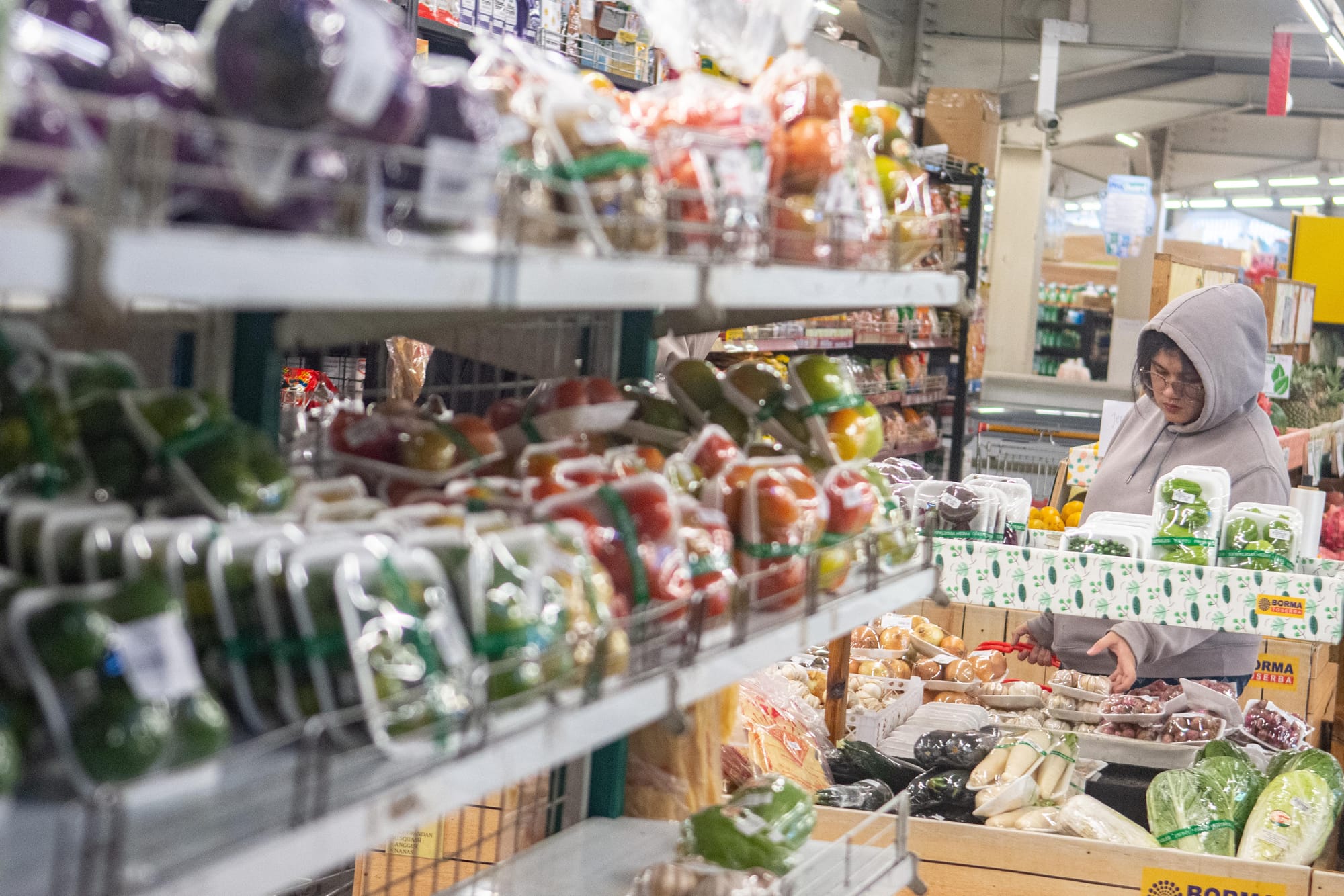
On the other hand, the slowdown in consumer goods group was relatively moderate (-1.6% WoW), mainly supported by supermarkets spending that still increased (+0.5% WoW). The robust medical and supermarkets spending shows that people are currently more defensive, or prioritizing the fulfillment of essential needs.
Andry Asmoro, often called Asmo, expects public spending in the third quarter of 2025 (3Q25) to grow slower. Using the cumulative MSI data for the first two months of 3Q25 (July and August 2025), spending was recorded to grow 37.2% YoY - lower than the cumulative growth of July and August 2024 (42.7% YoY).
Future trends
Asmo said, taking into account the remaining months in the third quarter of 2025 which lack momentum, his party estimates that national household consumption in this period will grow 4.86% YoY, lower than the growth in the third quarter of 2024, which was 4.91% YoY.
According to Asmo, the future prospects of the fast moving consumer goods (FMCG) market will depend heavily on the ability of companies to respond to the polarization of consumer purchasing power.
"Market value growth will continue to be supported by the high-end segment whose demand for premium and diverse products continues to increase," he said.
However, the overall sustainability of the market volume is determined by the ability of the products to remain affordable for the middle and lower segments. Thus, the industry outlook remains strong as long as players are able to balance product innovation with the right pricing strategy for both segments.
Chairman of the Association of Retailers and Shopping Center Tenants (Hippindo), Budihardjo Iduansjah, believes that Indonesia's retail potential is still very large.
"The modern retail sector in Indonesia is only around 25%. In developed countries, the strength of the economy is reflected in its retail development," said Budihardjo.
He said that in the midst of an economic slowdown, retailers must continue to innovate to provide a pleasant shopping experience that attracts visitors. This can be done by creating thematic decorations or certain discount promos.
Chairman of the Indonesian Retailers Association (Aprindo) Solihin stated that household consumption is still the pillar of the domestic economy. Despite the slowdown, the retail sector will still survive. This is because consumer goods are still the primary needs that consumers continue to look for.