

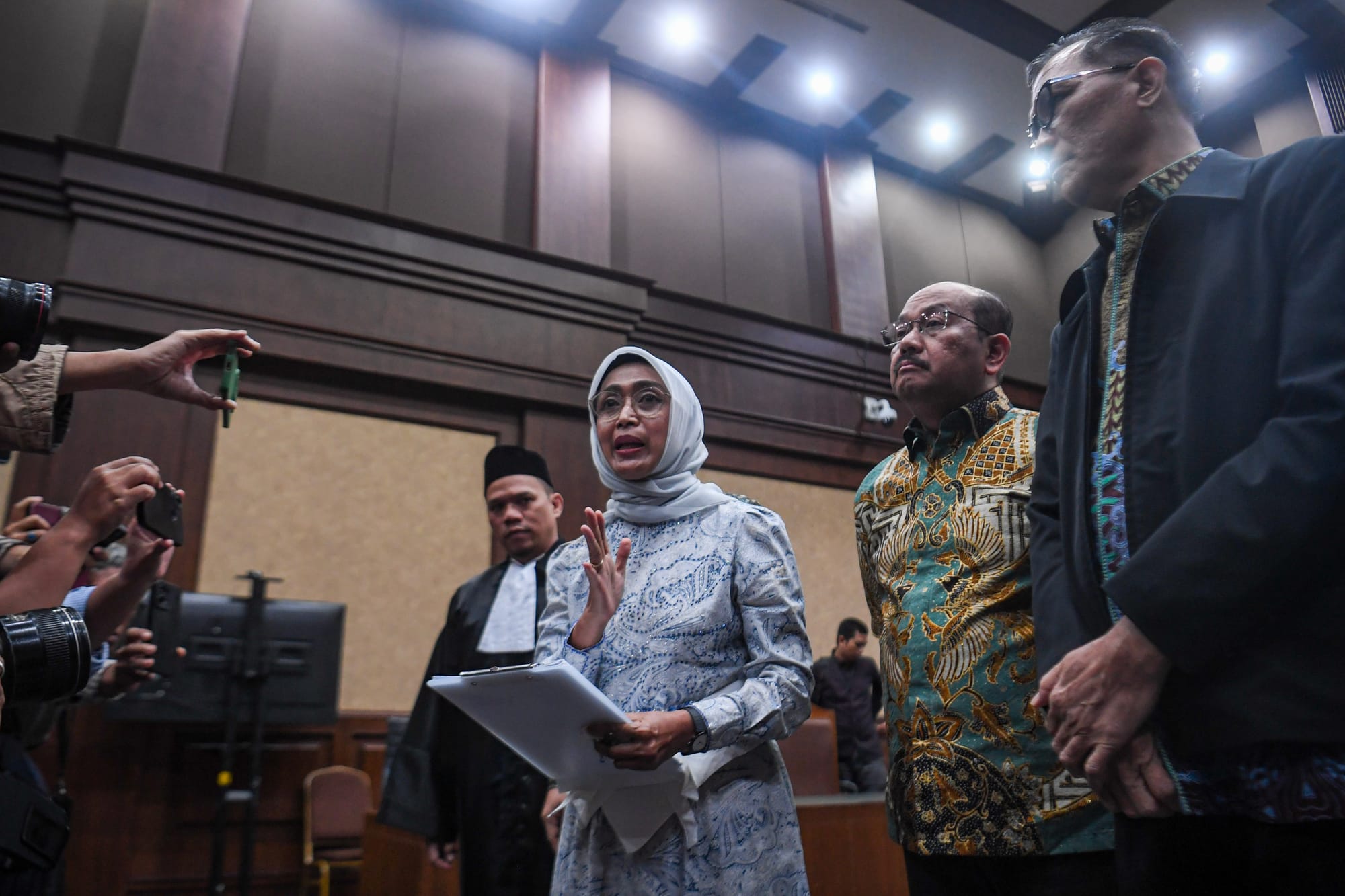
The verdict of the Corruption Court, Jakarta, Thursday (20/11/2025) against former President Director of PT ASDP Indonesia Ferry (Persero) Ira Puspadewi has sparked debate between the verdict of state losses, corporate decision errors, or the potential criminalization of BUMN leaders.
The prison sentence of 4 years and 6 months and a fine of Rp 500 million in lieu of 3 months were imposed because the panel of judges considered that Ira caused state losses of around Rp1.25 trillion during the acquisition of PT Jembatan Nusantara (PT JN) from 2019 to 2022. Five days later, on Tuesday (25/11/2025), President Prabowo exercised his right to rehabilitate Ira.
This case stems from ASDP's decision to acquire PT JN's assets and shares through a business cooperation scheme (KSU) that lasted several years. The Corruption Eradication Commission (KPK) assessed that the process involved abuse of authority because the acquisition was carried out when PT JN's financial condition was declining.
In the KPK indictment, the value of the company was declared negative based on the calculation of the forensic accounting team. The figure was used as the basis for determining state losses.
However, during the trial process, the panel of judges noted that there was no evidence of the flow of funds to the defendants, so no restitution was imposed.
The head of the panel of judges, Sunoto, even expressed adissenting opinion with two other judges, among others regarding the assessment of ASDP's business processes. The opinion is included in the verdict file.
On the other hand, there are differences in information from various parties regarding the calculation of state losses. The Supreme Audit Agency (BPK) stated that it only conducted a compliance audit of the PT JN acquisition process. The Financial and Development Supervisory Agency (BPKP) stated that it did not issue an official calculation of state losses for the case. KPK then used internal calculations to determine an estimated loss of around Rp1.25 trillion.
Is it state loss?
Director of NEXT Indonesia Center, Herry Gunawan, assessed that the debate over the authority of the board of directors in the acquisition of PT JN needs to be seen from the governance procedures that apply in SOEs.
According to him, material decisions, such as transactions worth around 20% of assets or profits, require commissioner approval and are usually decided through a general meeting of shareholders (GMS).
The ASDP acquisition plan has been included in the company's work plan, approved by the board of directors, and obtained the approval of the Board of Commissioners before it was carried out.
Herry referred to Article 97 paragraph 5 of Law No. 40/2007 on Limited Liability Companies, which states that directors cannot be held liable for the company's losses if they can prove good faith, prudence, and the absence of negligence.
He views ASDP's actions as falling within the business judgment rule because its internal processes are carried out according to the provisions. The criminalization in this case, he said, blurred the line between management discretion and alleged abuse of authority.
A process that has been supported by a risk assessment and no personal interests were found should be considered corporate action. "In my opinion, it was forced," he said.
To determine whether the board of directors has made an appropriate decision, Herry mentioned four main parameters, namely the presence or absence of fraud, conflict of interest, illegal actions, and negligence in risk analysis.
On the other hand, he considered that the limits regarding state losses in the ASDP case were not clear.
"What is the state loss, actual loss or expected loss?" he said.
Herry assessed that the lack of clarity could lead to gray articles targeting business decisions. Definition affirmation, he said, is needed so that SOE directors can obtain legal certainty in exercising their authority.
According to him, there have been other cases since 2020 with suspects since 2023, such as the case of the Indonesian Export Financing Agency (LPEI) but to this day it has not yet gone to court.
"Meanwhile, ASDP suddenly went to court. I think the law enforcement officers are flirtatious. There is an aroma of criminalization," he said.
Another legal view
Trisakti University criminal law lecturer, Abdul Fickar Hadjar, believes that this issue is related to the application of Article 3 of Law Number 20 of 2001 concerning Corruption Crimes.
Fickar explained that the article allows officials to be convicted even though they do not receive personal benefits if there are other parties or corporations that benefit.
Within that framework, the KPK still has a basis for using Article 3 as long as the element of harm to the state is considered fulfilled. "From the point of view of the KPK rules, it has a basis, and later in court it needs to be proven whether the directors worked properly," said Fickar.
Regarding the difference in information between BPK and BPKP, Fickar emphasized that SOEs should be treated as business entities. Losses in business activities can come from trade dynamics or from individual actions that abuse authority.
This distinction is important so that not all losses are automatically considered state losses. "What must be seen is whether the losses are business losses or losses caused by the behavior of the management," said Fickar.
According to Fickar, the KPK is not authorized to calculate state losses because this function is in the hands of BPK or state auditors who have an official mandate. He highlighted the KPK's use of the discounted cash flow method, which resulted in a calculation of PT JN's share value of around 38.3 billion rupiah and liabilities of 500 billion rupiah as the basis for projected losses.
"If the KPK calculates itself without the basis of an authorized institution, in my opinion it is invalid," he said.
This, said Fickar, could lead to the risk of criminalizing business decisions when trade losses are treated as state losses without clear distinction. He referred to judge Sunoto's dissenting opinion which considered the actions of ASDP directors as non-optimal business decisions, not criminal acts.
"This is a business risk, many cannot be proven as crimes," said Fickar.
On the other hand, in a release received by Suar, former BUMN Minister Dahlan Iskan highlighted the position of BUMN directors who often face the risk of criminalization when business decisions are questioned.
He considered Ira as a figure who has a strong track record in fixing ASDP and said that pressure on BUMN leaders can arise when the improvement process touches many interests.
Dahlan believes that the public's attention to Ira's case shows that the principle of business judgment rule is increasingly relevant in the debate on the limits of business decisions and criminalization. Although the concept has been included in a Constitutional Court decision, its application has yet to be seen in law enforcement practice. "What is clear is that no judge has ever used it," he wrote in the release.