
The government's decision to postpone setting the 2026 minimum wage should be used as an opportunity to open negotiations between employers, the government, and workers in order to reach a compromise that accommodates the interests of all three parties. Four alternative wage calculation policies are available as a starting point for dialogue that can still be opened.
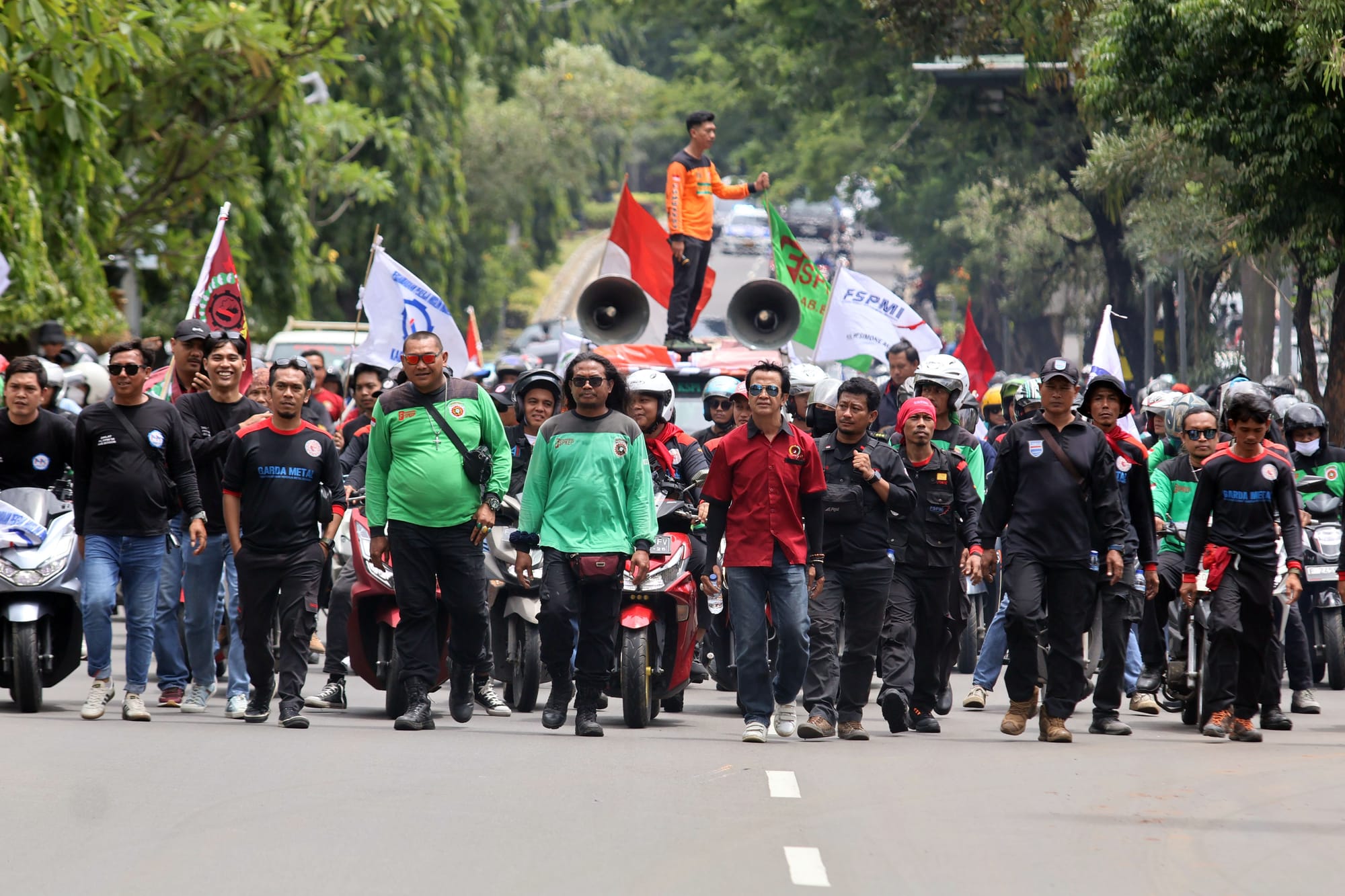
The President of the Indonesian Trade Union Confederation (KSPI), Said Iqbal, presented the four alternatives at a virtual press conference on Wednesday (12/3/2025). In his statement, Iqbal also emphasized the workers' rejection of the draft government regulation (RPP) on wages, which will be announced by Minister of Manpower Yassierli on Monday, December 8, 2025.
Iqbal cited three reasons why KSPI rejected the Draft Regulation on Wages. First, according to Iqbal, the Draft Regulation was decided without in-depth discussions that took into account the aspirations of workers. The government's stance was taken unilaterally based on input from employers, which was then communicated in a one-way manner to workers.
Second, the RPP includes an article on average worker consumption based on data from the Central Statistics Agency. If the average consumption figure is included, Iqbal ensures that wages for workers in the Greater Jakarta and East Java industrial areas will not increase because this figure reinstates the wage concept in Government Regulation No. 51/2023, which was rejected by workers and has been brought to the Constitutional Court for judicial review .
Third, certain index components (alpha) specified in the RPP are listed between 0.3-0.8 and will continue to apply. With an alpha of 0.3, Iqbal estimates that the minimum wage increase will only be 4.3%. When multiplied by the current average minimum wage of Rp3.09 million, the average minimum wage increase will only be Rp120,000.
"This figure is outrageous. When I went to Geneva for the ILO conference, a kebab cost USD 19, or nearly Rp320,000, for a single meal. If the average increase is only 4.3%, then the monthly minimum wage increase in Indonesia is lower than the price of a kebab in Switzerland," said Iqbal.
Four alternatives
In order to reach a consensus ahead of the 2026 minimum wage determination, Iqbal offered four alternatives in the wage calculation scheme.
- A 6.5% increase in the single minimum wage, in line with President Prabowo Subianto's directive last year.
- Taking wage disparities into account, KSPI opened the minimum wage increase interval between 6% and 7% based on considerations from employers who objected to excessive increases.
- In order to pursue economic growth and boost purchasing power, the increase interval was made more detailed, namely 6.5%-6.8%.
- When considering alpha to accommodate differences in inflation and economic growth between provinces/cities/districts, the proposed alpha value is in the range of 0.7-0.9, so that the gap is smaller than the RPP alpha of 0.3-0.8.
"When employers, the Minister of Manpower, the Minister of Industry, or the Wage Council warn that wage increases will lead to layoffs, that is a lie. There has never been a single case in Indonesia or anywhere else in the world where minimum wage increases have led to layoffs," Iqbal asserted.
The Chairman of the Labor Party explained that layoffs have tended to be driven by two factors. First, declining purchasing power due to very small wage increases, and second, textile and garment import regulations that have nearly killed domestic textile and garment factories. These two factors have been the main drivers behind factories reducing their workforce.
"In fact, when the minimum wage increases reasonably, purchasing power will increase. If I usually buy one shirt, with the wage increase, I can buy two shirts. Production can increase, and factories can recruit new employees to meet production needs," he said.
If the minimum wage increase at the provincial and district levels uses an alpha of 0.7, Iqbal calculates that the minimum wage increase can reach at least 6.3%, although there is a special case in North Maluku, which has high economic growth, so that with an alpha formulation of 0.7, the minimum wage can be increased by up to 21%.
"We have compromised from the initial request of an 8.5-10.5% increase. Now, 7% is sufficient because we have heard Apindo's views, but the decision must be correct. We offer the four alternatives above. Please, regents/governors, decide which alternative you want to use," he concluded.
Productivity determines
Of the four alternatives offered by workers as the basis for calculating the 2026 UMP, the disagreement lies in the value of a certain index (alpha), given that this value represents the contribution of worker productivity to economic growth. Therefore, a compromise will be reached if the alpha interval in the RPP Pengupahan accommodates the interests of both parties.
Deputy Chair of Employment and Human Resource Development at the Indonesian Garment and Textile Association (AGTI) Nurdin Setiawan said that the business world has agreed on the calculation of the minimum wage using the year-on-year inflation variable for September 2025, the average economic growth for Q4 2024-Q3 2025, and a maximum alpha of 0.5.
"For entrepreneurs, if alpha is set at more than 0.5, it is quite difficult for them. We see two figures. If the ratio of the Decent Living Needs (KHL) to wages exceeds 0.78, then the index can be smaller, between 0.1-0.3. But if it is still below KHL, it can be between 0.3-0.5," Nurdin explained to SUARon Wednesday (12/03/2025).
Furthermore, according to Nurdin, workers' demands to set alpha at 0.7-0.9 in the Draft Regulation on Wages means that labor productivity has reached 70-90% of economic growth. This claim can be accepted if the Central Statistics Agency proves the productivity figures of workers in each province through an authorized institution. Productivity figures will facilitate the calculation of labor's contribution to economic growth.
"When we don't have productivity figures that serve as a reference for the alpha value in a region, there will be ongoing debates between employers and workers," said Nurdin.
Read also:
 Benedictus Krisna Yogatama
Specifically, Nurdin refuted Said Iqbal's concern that workers' wages in the Jabodetabek and East Java industrial areas would not increase due to the inclusion of average consumption figures in the RPP. The reason is that even with 0% economic growth, there is still an inflation measure that forms the basis for calculating the UMP.
"With a growth rate of 5% and inflation of 2.5% multiplied by alpha, there will certainly still be an increase, but it will likely be in the range of 2.5-3.5%. With the current formula, I don't think there will be the feared 0% increase," he said.
Three-party effort
The heated debates that occur every year ahead of the minimum wage determination serve as a reminder of the need for open, high-quality deliberations that involve listening to each other's needs.
Labor and industrial relations practitioner Zamzam Mashan emphasized that, thus far, common ground has often not been reached because the three variables used to determine minimum wages—inflation, economic growth, and the alpha index—do not address the root causes of labor issues, namely increasing workers' purchasing power and improving their welfare in a sustainable manner.
"So it's no surprise that every time the UMP is set, there is almost always resistance from workers, as well as from employers if the UMP increase is considered too high and irrational," said Zamzam when contacted on Wednesday (03/12/2025).
According to Zamzam, the existing Job Creation Law and Government Regulation on Wages stipulate that a lawsuit must be filed with the State Administrative Court if the minimum wage is set by the regional head. In other words, the existing regulations do not facilitate consultation and dialogue to the fullest extent as a method of dispute resolution, instead of ensuring that the dialogue addresses the root causes of the problems experienced by workers.
As long as the regulatory corridor does not allow it, according to Zamzam, the agreement on the minimum wage needs to combine the government's efforts to improve the national economic structure through various incentives for the business world to absorb workers in labor-intensive sectors, with the business world's efforts to seek efficient financing and utilize workers productively by strengthening product competitiveness.
"For workers, the needs of the business world can be responded to by continuously improving work quality and competitive skills , in addition to implementing targeted consumption and side jobs as a safety net in the event of layoffs," he concluded.