For years, regional budgets have depended on transfers from the central government. Now, with a significant reduction in regional transfer funds (TKD) in the 2026 State Budget (RAPBN 2026), this could become an opportunity for local governments to achieve fiscal independence.
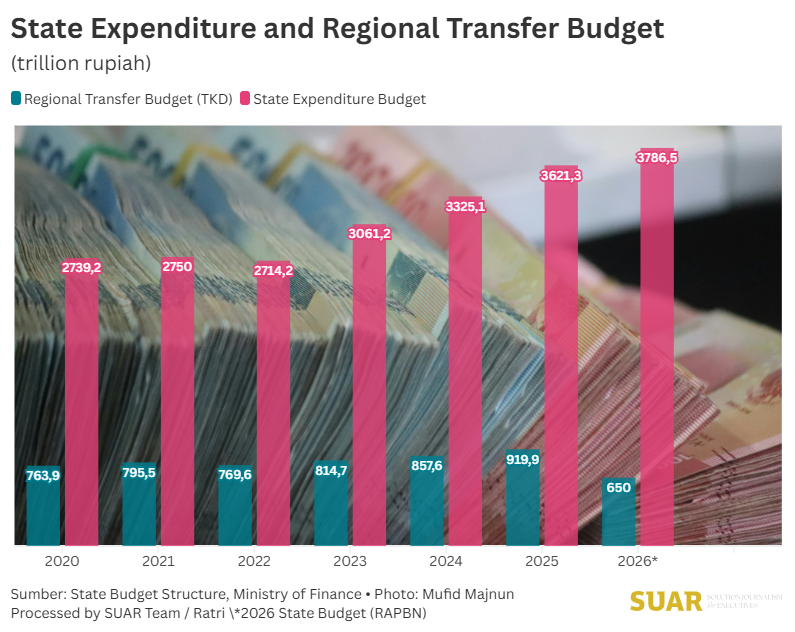
In the 2026 RAPBN presented by the government last Friday (August 15, 2025), the allocation of transfers to regions (TKD) decreased by around 29% compared to the 2025 State Budget, totaling IDR 650 trillion. This presents a challenge for many local governments that have long relied heavily on central funds. However, this reduction can also be seen as a momentum for regions to strengthen their fiscal autonomy.
The TKD reduction is part of the central government’s policy shift to make state spending more efficient. Funds previously channeled through TKD are now redirected to central government spending aimed directly at priority programs in the regions, such as the People’s Schools program, Red and White Village Cooperatives, national food security, and Free Nutritious Meals (MBG).
To reduce dependence on central government funds, regions need to optimize revenue from internal sources. One key indicator of a region’s financial independence is its local revenue (PAD). Until now, most regions in Indonesia have been highly dependent on central transfers, with PAD contributing only around 28.7% of regional revenue in 2024.
In fact, according to the 2023–2024 Provincial Government Financial Statistics report by the Central Statistics Agency (BPS), there is an optimism among provincial governments about their ability to increase regional independence. This is reflected in the rising contribution of local revenue (PAD), which reached IDR 233 trillion or 56.60% of regional revenue. The majority of this revenue comes from regional taxes (2024), while transfers from the central government remain the second-largest contributor to regional income (42.71%).
The reduction in TKD not only provides an opportunity for local governments to explore their regional potential to boost PAD but also increases revenue from the management of regional assets through regional-owned enterprises (BUMD) and MSMEs. This opportunity encourages regions to build stronger fiscal capacity and create a more resilient and sustainable local economic model.