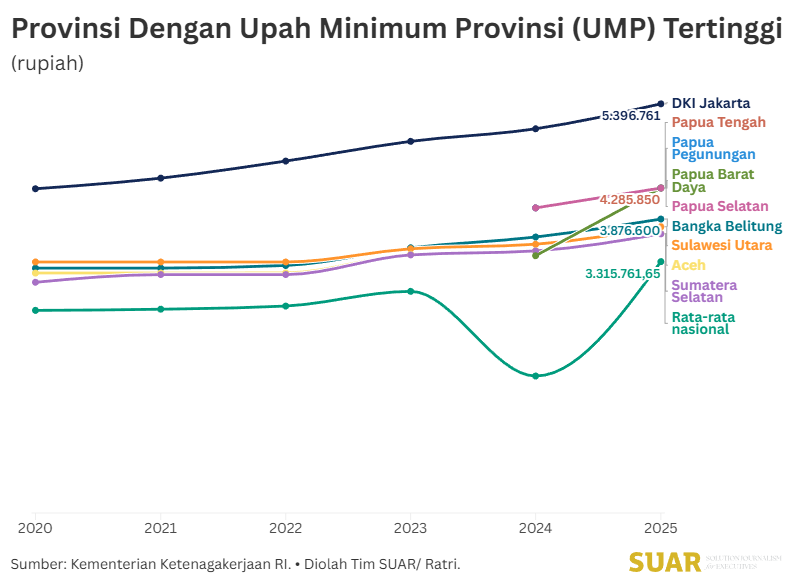
In 2025, the Provincial Minimum Wage (UMP) increased by an average of 6.5%. In some regions that are New Autonomous Regions (DOB) in Papua, the UMP increase is higher.
DKI Jakarta's UMP in 2025 is recorded as the highest UMP with an amount of IDR 5,396,761. This figure reflects the high cost of living and economic activity in the metropolitan area. Four DOBs in Papua, namely Central Papua, Mountainous Papua, Southwest Papua, and South Papua have the highest UMP after DKI Jakarta, surpassing other provinces.
UMP determination considers the cost of living, with a formula of inflation, economic growth rates, and certain indices. DKI Jakarta's high UMP is supported by an economic structure that relies on the Wholesale and Retail Trade sector 18.01% and Financial Services and Insurance 11.49%. The financial and service sector is known for its ability to pay wages well above the UMP. In addition to illustrating the high cost of living in the capital city, the amount of UMP is also due to the high productivity of the tertiary sector.
The character of a region's economic activity influences wage levels. North Sulawesi, for example, which is included in the top 10 provinces with high UMP, with a UMP of IDR 3,775,425.00, is supported by activities in the agriculture, forestry and fisheries sector 20.59% and wholesale and retail trade 3.65%. Activities in these sectors cannot be separated from the position and function of North Sulawesi as the gateway to eastern Indonesia.
UMPs characterized by other economic activities are also evident in the provinces of Bangka Belitung and South Sumatra, whose UMPs are dependent on commodity-based sectors. Bangka Belitung, with a UMP of IDR 3,876,600.00 in 2025, the majority of its provincial GRDP is supported by mining and quarrying at 20.6%, which has historically been dominated by tin. South Sumatra with a UMP of IDR 3,681,571.00 has a very strong economic base in the coal and lignite mining sector 24.6%, and Agriculture, Forestry and Fisheries 18.27%. The extractive sector, which tends to be productivity and capital intensive, indirectly drives the increase in minimum wage standards in the region.
DOBs in Papua such as Central Papua, Mountainous Papua, Southwest Papua, and South Papua in the highest UMP position after DKI Jakarta with the amount of Rp 4,285,850.00 to Rp 4,285,849.00 is a phenomenon driven by the high Decent Living Needs (KHL) and extreme logistics costs.
Southwest Papua, for example, saw its UMP increase by 26%, representing a drastic adjustment to the cost of living in the activity-intensive Sorong region. Although sectoral GRDP distribution data is not yet available for the DOB, the high UMP is assumed to be supported by strategic sectors such as Oil and Gas Mining and Construction Services and Government Administration which pay higher compensation due to risks and geographic isolation.
The high minimum wage in DOB Papua, although aimed at the welfare of the people, faces sustainability challenges. A high minimum wage will burden the newly growing business sector, including local UMKM .