Indonesia’s manufacturing sector, already under strain, is calling for stronger assurances of affordable natural gas prices and steady supply to regain momentum.
The pressure is evident in the country’s Purchasing Managers’ Index (PMI), which has contracted for four consecutive months. S&P Global reported a reading of 49.2 in July 2025, below the 50-point threshold that separates expansion from contraction.
That follows 46.7 in April, 47.4 in May, and 46.9 in June, underscoring weak orders and rising input costs.
“Affordable natural gas prices and guaranteed supply are what we need,” Yustinus Gunawan, Chairman of the Forum of Industrial Users of Natural Gas (FIPGB), said on Aug. 10. He noted that gas accounts for between 15% and more than 50% of production costs in some sectors.
The government is seeking to address this through the Specific Natural Gas Price (HGBT) program. Under HGBT, gas supply is allocated to seven manufacturing sectors - fertilizer, petrochemicals, oleochemicals, steel, ceramics, glass, and rubber gloves - at US$6.5–US$7 per MMBtu (million metric British thermal unit).
According to Josua Pardede, Chief Economist at Bank Permata, HGBT functions as a cost-side automatic stabilizer in the current environment. The fixed price caps the energy component of production costs, eases input-cost pressures, and helps keep plant utilization from falling further as demand weakens.
“In other words, HGBT cushions the cost side so the decline in output does not deepen,” he said.
Josua added that the PMI contraction since early 2025 underscores weaker new orders and rising input prices, making energy-cost intervention increasingly urgent to prevent a sharper drop in output.
HGBT levels—US$6.5 per MMBtu for feedstock and US$7 per MMBtu for fuel—sit at the lower end compared with Asia’s LNG-based prices and Indonesia’s domestic LNG prices, which can reach US$16.77 per MMBtu. The gap, he said, “can reach 40% to 60% and is a material factor in preserving selling-price competitiveness and in factories’ decisions to keep operating.”
However, Josua noted that incomplete realization of HGBT has created two-tier energy pricing on the factory floor, making production costs more volatile and influencing business strategy. The impact of constrained supply, he said, is evident in the ceramics industry, one of HGBT’s target users.
Still Short of Expectations
Yustinus Gunawan of the Forum of Industrial Users of Natural Gas (FIPGB) said the realized volume under the Specific Natural Gas Price (HGBT) scheme must reach 100% of the allocation set in the Energy and Mineral Resources Minister’s Decree to have a real impact on industry. As of July 2025, he added, PGN’s realization remains far below the allocation.
The same complaint came from Edy Suyanto, Chairman of the Indonesian Ceramic Industry Association (ASAKI). He said HGBT quotas realized for ceramics are only about 60% in the western region and 40% in the eastern region.
For the remainder, companies must buy regasified LNG at US$14.8 per MMBtu, far above HGBT prices. If this continues, he warned, production capacity will be increasingly constrained and jobs could be cut.
“This situation erodes competitiveness and forces many plants to produce only up to the gas quota they receive,” Edy said.
Zinedine Reza, Executive Director of Indonesia Development Energy and Sustainability (IDEAS), noted that although the policy provides price certainty at US$6.5–US$7 per MMBtu for seven strategic industrial sectors, there are reports from businesses of actual prices exceeding those levels.
He said information on beneficiaries, allocated volumes, and the distribution chain of subsidized gas should be disclosed systematically to maintain public and business confidence.
Price disparities and mismatches in volumes received indicate the need to evaluate the current distribution mechanism, he added.
“If distribution data can be accessed openly, civil society and industry participation in overseeing the policy can be strengthened,” he said in a press statement, Friday (8/8/2025).
From industry, Agus Riyanto, Executive Director of the KAHMI Textile Chapter, said access to industrial gas at affordable prices is critical to the competitiveness of labor-intensive sectors such as textiles.
“In practice, many textile companies still do not consistently feel the benefit of US$6 per MMBtu gas. Clear distribution mechanisms and guaranteed supply are what we expect,” he said in a press release.
IDEAS also urged an independent audit of HGBT distribution and regular publication of distribution data and its impact on industry.
“We believe that by improving governance and building a culture of transparency, our energy policy can contribute more to national industrial competitiveness and public welfare,” Zinedine said.
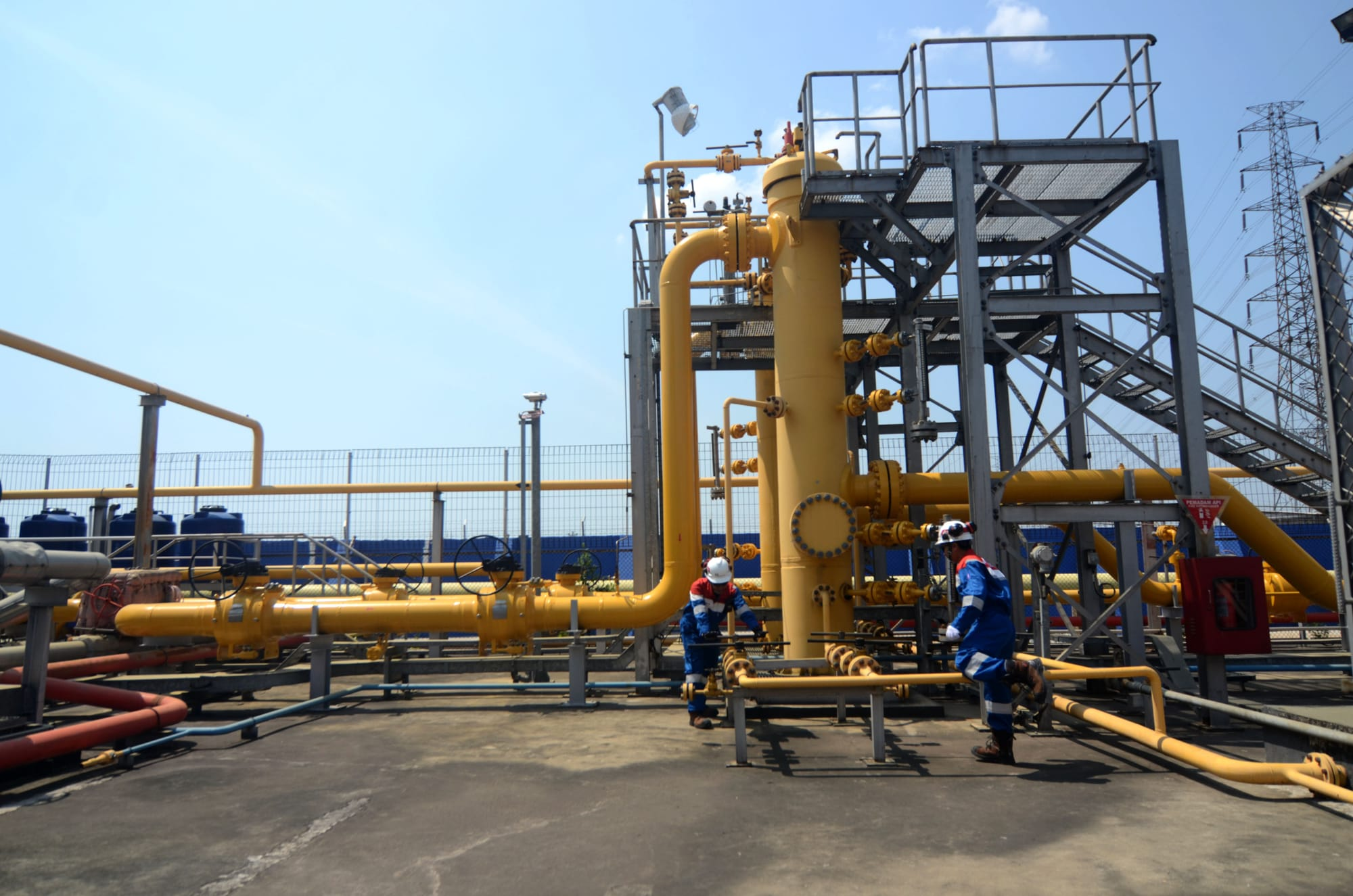
Energy and Mineral Resources (ESDM) Minister Bahlil Lahadalia said the government is committed to supplying natural gas for domestic needs. He noted that 61% of first-half 2025 natural gas production—5.598 billion British thermal units (BBTU)—was allocated to the domestic market.
“Make the most of our natural resources for domestic needs,” Bahlil said at the ESDM Ministry’s H1 2025 performance press briefing, Monday (11/8/2025).
Industry Minister Agus Gumiwang Kartasasmita said the Specific Natural Gas Price (HGBT) policy can boost industrial competitiveness, as it has proven to lower production costs and improve operational efficiency for manufacturers in industrial estates.
He added that, under Law No. 3/2014 on Industry, companies are required to be located in industrial estates—an arrangement that benefits firms through integrated infrastructure, including energy feedstock supply.
However, Agus acknowledged implementation hurdles for HGBT on the ground, despite the policy being affirmed and reinforced by Presidential Regulation (Perpres) No. 121/2020 on Natural Gas Pricing.
“HGBT must continue, but its implementation has not yet been optimal across all industrial estates,” he said.