

President Prabowo Subianto's goal of achieving 8% economic growth by 2029 is an ambitious, yet realistic target given Indonesia's potential. In order to go beyond numbers, attention to the quality and impact of growth is important amidst the world turmoil that is preparing for the birth of a new economic order. Holistic and technocracy-based policies are key.
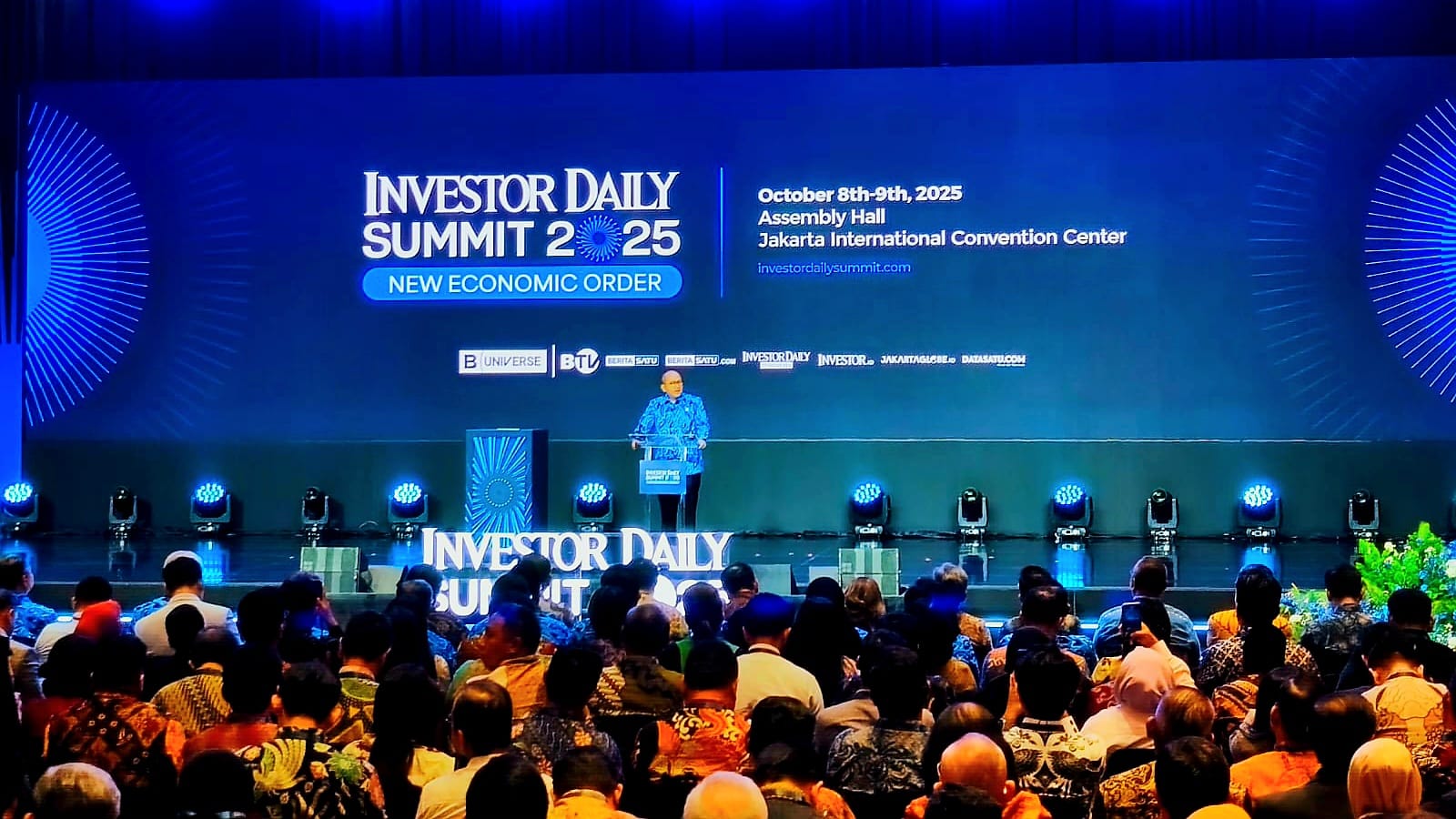
This message became the 'red thread' in the public discussion"Indonesian Economy in the New Economic Order" which was part of the Investor Daily Summit 2025 at the Assembly Hall of the Jakarta Convention Center, Wednesday (8/10/2025).
As the fourth event since 2022, this year's forum carries the theme"New Economic Order" which summarizes the awareness that the world is writing a new chapter, and with a strategic vision, Indonesia can become a major player, not just a spectator.
Minister of Investment and Downstream/Head of the Investment Coordinating Board (BKPM) Rosan Roeslani emphasized that Indonesia must be able to navigate a world that is not okay amid tariff policies, war, and dynamic tensions. This is because Asia is the pulse center of the world's future, and Indonesia has an important place in it.
"By 2030, 4.5 billion or 60% of the earth's population will come from Asia. Asian economies are growing at an average of 4.5% each year. In Southeast Asia, Indonesia can be a natural leader with 36% of the population and 40% of the land area. We must fulfill this leadership role," Rosan said.
Rosan, who is also the CEO of Danantara's Investment Management Agency (BPI), revealed Indonesia's dual strategy to achieve targeted growth.
On the one hand, Indonesia opens up to various initiatives, ranging from RCEP, BRICS, OECD, to IPEF. On the other hand, Indonesia is also strengthening productivity as well as the capacity and quality of human resources so as not to depend on certain countries/blocs.
By opening up through various initiatives, Indonesia is ready to attract investment with a total value of USD 814.6 billion or IDR 13,032.8 trillion until 2029. For this year, the investment realization that has entered in the first semester of 2025 reached IDR 942.9 trillion or 49.5% of the target of IDR 1,905.6 trillion. Of this amount, 1,259,868 jobs have been opened.
Rosan, who was previously the Indonesian Ambassador to the United States, said that he is waiting for the realization figures until the end of this year, but the government's steps going forward are certain, ranging from policy reforms, to boosting the quality of human resources.
"Reduce red tape, so that we can invite quality and sustainable investment. In addition, job creation is also accompanied by improving the qualifications of our talent pool with vocational education which is very important," he said.
The government's current focus, according to Rosan, is to maximize domestic consumption and investment as the main pillars of economic growth. In addition, the Danantara he leads will also empower the private sector to ensure that the large economic cake is distributed fairly and sustainably.
Headed in the right direction
The government's commitment to maximize domestic growth potential received a positive response from the economists who were also present. However, there are still facts from the field that need to be considered so that the commitment to achieve the target does not lull us into the wrong direction.
Representing the Alliance of Indonesian Economists, Talitha Chairunnisa said that with a strong foundation amidst the turmoil, Indonesia's stable growth and economic recovery should be appreciated. The world is now looking at Indonesia as a new economic power from the South of the Earth.
However, Talitha emphasized that there is great potential that has not been fully realized. The evidence, she reports, is that economic growth above 5% is not linear with real wage increases of only 1.2% per year. New jobs are growing at 80%, but only in the low-wage household sector.
"With a tax ratio of 10.5 to 11% of GDP, we do not have the luxury of spending wrongly. However, we see that 37% of the 2026 state budget is allocated to populist programs. This means that Indonesia is not in fiscal deficit, but in priority deficit," he said.
Sharing Talitha's view, economist at the Institute for Economic and Social Research, Faculty of Economics and Business, University of Indonesia (LPEM FEB UI) Rizki Nauli Siregar revealed that real wage increases that are not in line with economic growth make growth not felt by the middle class.
"Compared to East Asia and the Pacific alone, our labor productivity is still far below. This considerable slowdown in growth is a sign of urgency, but also a signal that we need growth that can create high-income jobs," Rizki explained.
Efforts to boost productivity, he continued, can be taken in several ways, starting from increasing Indonesia's persistently low participation in global supply chain-integrated manufacturing trade over the past 30 years.
In addition, Indonesia needs to formulate industrial policies that are holistic, attentive to distribution, and do not create bottlenecks. In addition, the government needs to identify and support enabler industries, namely modern service industries that support other industries, such as transportation and finance.
Deputy Dean of FEB UI Kiki Verico revealed that the decline in the contribution of manufacturing to Indonesia's GDP over the past 30 years cannot be separated from the increase in the Incremental Capital Output Ratio (ICOR) figure to reach 6.5. In fact, 40 years ago, Indonesia's ICOR was only 4.4, making it attractive for investment.
"Anyone who wants to improve the economy must start from the real sector, do not disturb the financial sector. Create jobs, period. From where? Investment. The basis of investment is regulatory reform to meet the quality of regulations that meet international standards. That is what will be seen when investors come in," he said enthusiastically.
With the pace of disruption around the world, according to Kiki, Indonesia needs investment of up to Rp11,000 trillion to achieve high growth, while over the years Indonesia has only Rp6,600 trillion. The need must be patched up immediately.
"We are just doing nothing , let alone doing something but being counterproductive. At present, when world economic growth falls, return on capital is higher than return on income. This means that workers are increasingly underutilized. We need agile policies to deal with this, with a strong technocratic base," said Kiki.
Talitha added that the quality of economic growth will only be evident if strong state institutions can guarantee that every rupiah of state revenue from economic growth will return in the form of public services. In other words, Indonesia needs to reorganize the rights and obligations between the state and the people.
"We are at a crossroads, we have great potential, but we are also faced with choices. The human resources are ready, but they must be welcomed by the right and evidence-based policies. Our role is to keep pushing the government to get there. Now is the time, don't delay it anymore," he concluded.