

The Directorate General of Customs and Excise (DJBC) of the Ministry of Finance received 7,219 reports of fraud as of November 2025. The majority of complaints, namely 61% or 4,462 complaints, involved online shopping. Based on this experience, the DJBC intensified two improvement strategies: intensifying the Stop Cek Lapor campaign ahead of National Online Shopping Day (Harbolnas) and launching a new version of the beacukai.go.id website with a number of service feature improvements.
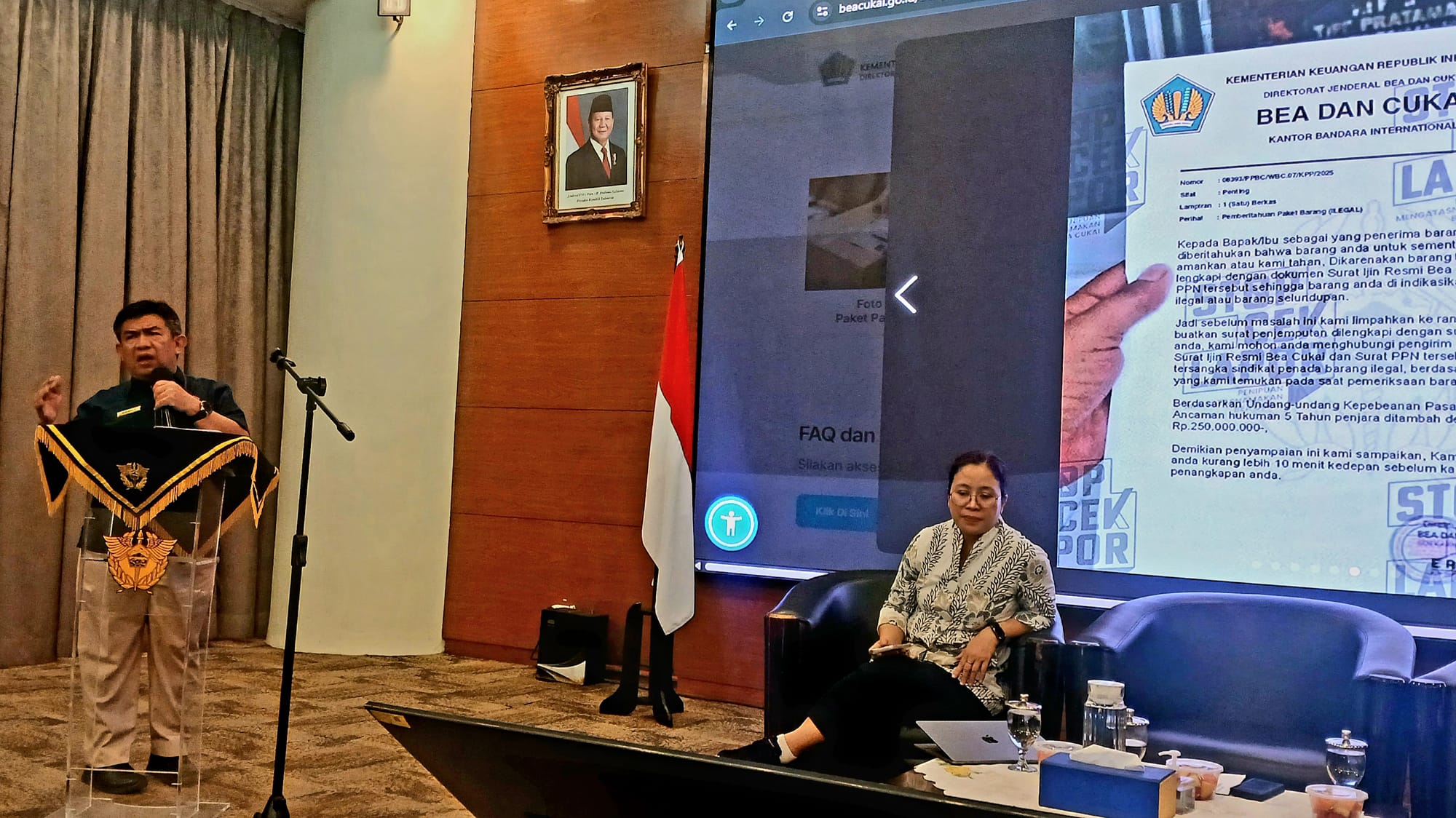
Director of Communications and User Guidance for Customs and Excise Nirwala Dwi Heryanto explained that of the 7,219 reports of fraud committed in the name of Customs and Excise, 4,468 were reports without losses, i.e., fraud attempts that were successfully prevented because the public was immediately alert and reported them. Meanwhile, 2,751 complaints were reports of losses, meaning cases that resulted in victims losing money.
"One of the victims was a cleaning service employee who tried to buy beauty care products. He did not buy them from a marketplace, but from an untrustworthy online shopping site, and was cheated out of Rp70 million. We are trying to help report this to the police and are following developments," said Nirwala in a media briefing in Jakarta on Wednesday (10/12/2025).
Thousands of massive cases of fraud committed in the name of Customs and Excise have become the main motivation for the DJBC to intensify its "Stop Cek Lapor" campaign. This is a public protection and education initiative to enable the public to easily recognize, confirm, and report fraud, especially in the lead-up to National Online Shopping Day, which falls on December 12, 2025.
"Every fraud case causes harm to the victim and to the Customs and Excise institution. However, because this is a complaint-based offense, we cannot force victims to file a complaint. This campaign is a preventive measure with three simple steps: stay calm and do not rush to respond to threats, check through official channels, and report immediately through our website or contact center," he explained.
Supplementing Nirwala's explanation, Populix Director of Policy and Society Research Vivi Zabkie explained that based on Populix's research on 500 victims of fraud committed in the name of Customs and Excise, the majority of victims were from Generation Z, who are hyper-digital and tech-savvy. This situation implies that fraud perpetrated in the name of official institutions can target anyone, including groups that are highly integrated with gadgets and the digital world.
"There is a significant gap in procedural understanding, and the most digitally literate groups are actually the least accessible to campaign information. Not to mention that fraudulent information from informal channels often arrives before victims have a chance to verify it with official customs sources," said Vivi.
Read also:
 Tria Dianti
Populix research findings reveal that there are five major types of fraud committed in the name of Customs and Excise: online shopping, romance and other interpersonal relationships (love scams), money laundering, auctions, and IMEI unblocking . A number of factors enable fraud, including infrastructure gaps, access, and the pace of digital development between regions.
"The most successful tactic is the use of very convincing and professional language, building instant trust by using the name and logo of the customs agency. WhatsApp calls and phone calls disguised as coming from official agencies make it easier for these fraudsters to reach their targets," he explained.
According to Vivi, the "Stop Cek Lapor" campaign strategy, which relies on quick responses from official channels, is very appropriate because the official WhatsApp channel and the DJBC website are the main sources of information verification, in addition to the contact center that can be contacted Monday through Sunday. However, the campaign still requires a multi-layered strategy for more effective communication.
"Different generations require different approaches. Campaigns targeting Generation X should focus more on Facebook and television, which reach remote areas. Campaigns targeting Generation Y/millennials can use interactive content on Instagram and YouTube, while Gen Z is more effectively educated through TikTok," he concluded.
More reliable
In addition to intensifying the "Stop Cek Lapor" campaign, DJBC also launched a new look for the beacukai.go.id website. This new website is part of DJBC's digital transformation to provide more transparent and adaptive public services in line with user needs. Head of the Print and Digital Publication Management Section at DJBC, Agus Cahyono, explained a number of differences between the old and new websites.
"The old website required more than two steps to find content, was not to the point in terms of the content to be displayed, and required multiple layers of searching. The visual display was not eye-catching. The content of the old website also supported the needs of the organization more than the needs of Customs service users," said Agus.
With a new concept that is faster, cleaner, and simpler, the new beacukai.go.id website does not have too many buttons, is more reliable, and is functional. All official DJBC services, ranging from export procedures, import procedures, licensing, to import and export tariff simulations, are listed completely and integrated on one page.
One of the standout features of the new beacukai.go.id website is the CEISA 4.0 virtual assistant named Tasya, which is installed on the browser. This virtual assistant is capable of compiling all the latest information based on the DJBC database, guiding users to access comprehensive service features, ranging from import regulations, IMEI checks, reporting procedures, to the latest weekly information on the Basic Customs Duty Payment Rate (NKDPBM).

"The content on the new website is not just what we want to display on the site, but what is truly useful for users. We strive to make information mapping easier for all user groups. In the future, the news site will be released separately, but this site is prepared as a one-stop service for service users, especially exporters and importers," Agus concluded.
Separately, Chairman of the Indonesian Chamber of Commerce and Industry (Kadin) Anindya Bakrie emphasized that the business world welcomes the government's measures to strengthen national export performance amid global geopolitical dynamics, such as logistics efficiency, data modernization, and collaboration with law enforcement agencies and fiscal authorities in creating certainty and comfort in doing business.
"Like a chicken, it cannot be stressed, because if it is stressed, it cannot lay eggs. As economic actors, the business world not only needs legal certainty, customs regulations, and taxes that must be implemented, but also the comfort of doing business to achieve economic growth above 5 percent," said Anindya in Jakarta on Tuesday (12/08/2025).